Why AI does not reach the P&L, and how we take it there.
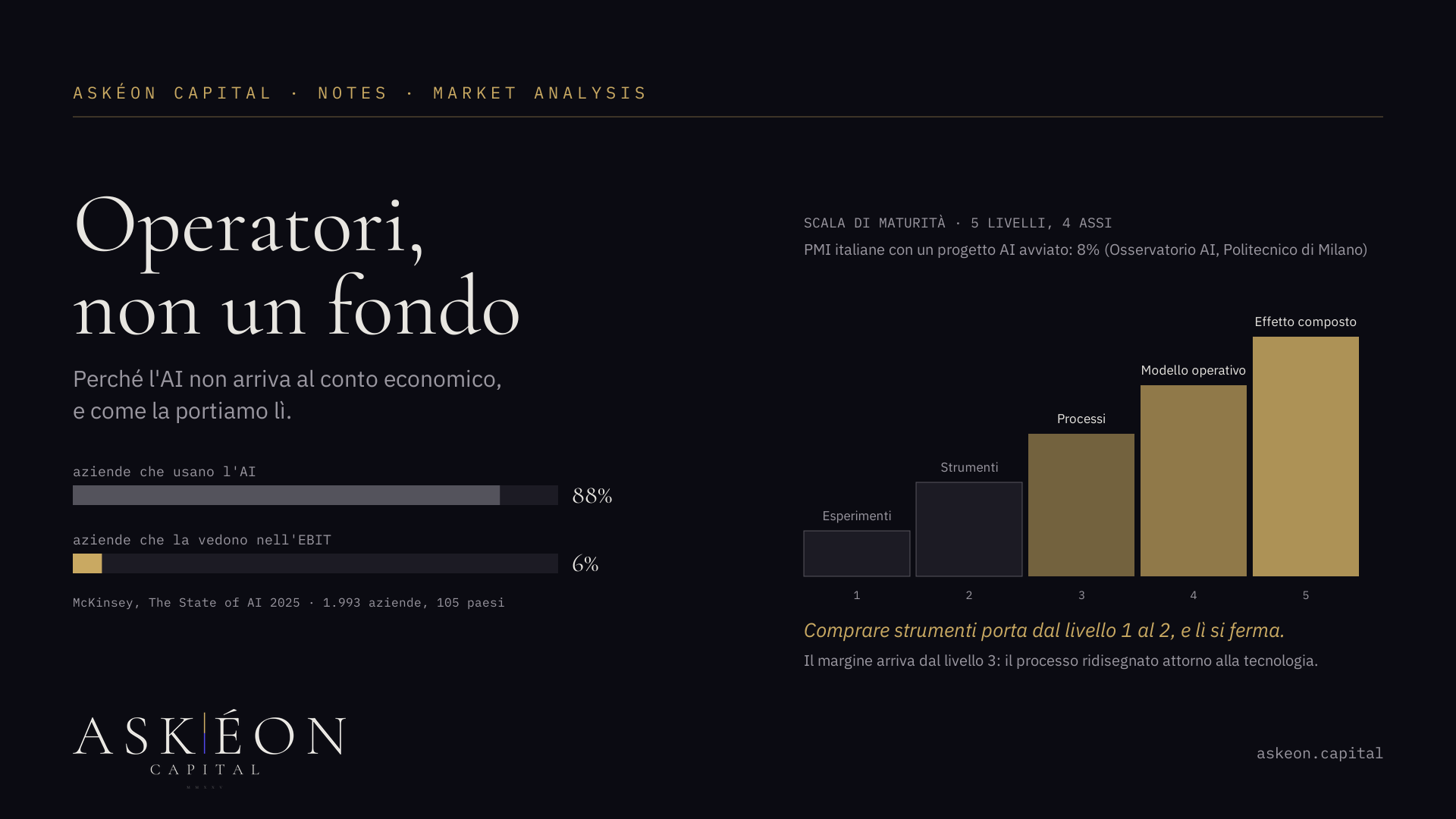
88% of companies use artificial intelligence in at least one function. Only 6% see it in EBIT (McKinsey, The State of AI 2025). The convenient explanation is that the technology is immature. It is wrong: the problem is where it is put.
Linear processes, exponential technology
Almost every company's processes were designed for people working one step at a time. A request arrives, someone works on it, passes it to someone who checks it, who passes it to a third person who approves it. Total time is the sum of the steps, and the bottleneck is always the slowest human step.
Putting AI into one of those steps makes it instant. But the next step is still human, and the work stops there and waits. The gain piles up in front of the bottleneck and never reaches the end of the line, the P&L.
Meanwhile the technology does not wait. The length of tasks an AI system can complete on its own doubles roughly every seven months (METR). A capability that doubles, placed inside a process that adds up, produces a gap that widens every year: the better the technology gets, the more the linear process wastes.
It has happened before, with electricity. For thirty years factories replaced the steam engine with an electric motor and left everything else as it was, and productivity did not move. The leap came when the factory was redesigned around the new technology. I told that story in Six percent.
The first step is not choosing a technology
It is measuring the starting point. We use a five-level maturity scale:
- Experiments: isolated attempts, often vendor-driven, with no KPIs.
- Tools: licences bought and used inside the old processes.
- Processes: at least one process redesigned around AI, with a measured KPI.
- Operating model: AI in how the company decides and works, with internal owners.
- Compounding: each improvement feeds the next; services and revenue built on data.
Buying tools moves you from level 1 to level 2 and stops there. Margin appears when the process is redesigned around the technology, and compounds when the operating model is.
We measure it on four axes: data, processes, people, systems. Most Italian SMEs sit between the first and second level: only 8% have an AI project under way (Artificial Intelligence Observatory, Politecnico di Milano). From there we decide where AI goes, in what order and with what return.
The path: the owners decide at every step
- Diagnostic. We start from the financial statements and the business. One assessment of processes and infrastructure, for AI and for security: the output is the levers quantified in euros of EBITDA and a ranked list of use cases by impact, cost and readiness.
- Plan. A 36-month roadmap with timelines, costs, business case and first hundred days.
- Technology and delivery. One use case at a time in production, with a measured KPI and an internal owner. No platform to sell, no vendor commissions.
- People. Role-based training and internal champions. AI and security training is no longer optional: the EU AI Act (Art. 4) requires AI literacy from organisations using AI systems, and NIS2 requires regular training from entities in scope.
- Value. Higher EBITDA and a company an investor can read.
No phase starts without the checkpoint of the previous one.
Three horizons, one balance sheet
H1 · 0–12 months · Margin. The same processes as today, decided with data. Measured on cost per transaction, cycle time, error rate and cash released from working capital. Low risk, return in months: the margin released funds the rest.
H2 · 12–24 months · Revenue. Pricing, customer coverage, speed of quotation. Measured on revenue per customer and customers lost unnoticed.
H3 · 24–36 months · New models. Services a company with linear processes cannot sell: data shared across the value chain, value-added services, recurring revenue.
Same revenue, a different company
Enterprise value is EBITDA times a multiple. Horizon 1 raises EBITDA; horizons 2 and 3 raise the multiple, because recurring revenue and demonstrable data lower the risk seen by banks, buyers and heirs. How much it is worth is decided by the numbers after the diagnostic, not before.
Who we are
We are not a fund and we do not manage third-party capital. We are operators: twenty years at Microsoft, Accenture, Deloitte, EY, KPMG and inside Italian companies, where technology meets the P&L. When a company has operations, vision and technology to develop, we can also take equity with an operating role: industrial capital, not financial engineering.
If you want to understand where AI is really worth it for your company, we start from your financial statements: book a call.
Sources: McKinsey, The State of AI 2025; METR, Measuring AI Ability to Complete Long Tasks (2025); Paul A. David, The Dynamo and the Computer, American Economic Review, 1990; Artificial Intelligence Observatory, Politecnico di Milano, 2026; maturity scale adapted from the Gartner AI Maturity Model.