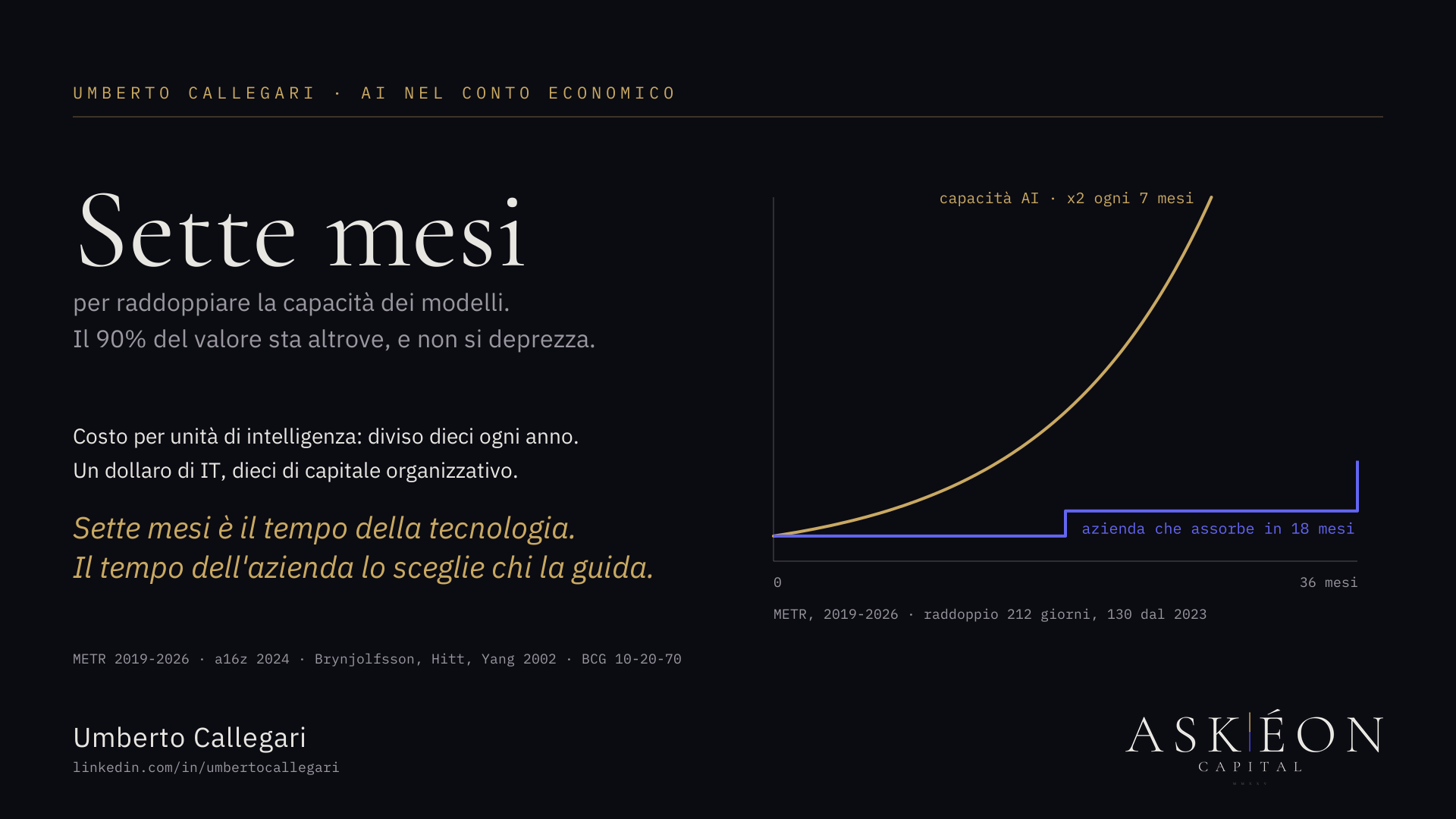
Every seven months, the length of the tasks that an artificial intelligence system can complete on its own doubles. This is what METR measures, the institute that has spent years tracking model capability on real tasks: in 2019 it was seconds, at the start of 2025 one hour, and by February 2026 over ten hours of equivalent human work. The doubling period estimated across the entire 2019-2025 series is about 212 days. For models released from 2023 onwards, it drops to about 130. No industrial technology has ever moved like this: not electricity, not the computer, not the internet.
On the other side is the cycle by which a company decides. Budget in October, business case in January, vendor selection in spring, pilot in summer, evaluation at year-end, scaling in the following budget. Eighteen months from need to result, in the best case. In eighteen months, the technology on which the business case was built has doubled three times. The pilot, when it reaches evaluation, measures something that no longer exists.
This explains the number that everyone cites and no one explains. 95% of generative AI pilots produce no measurable effect on the P&L (MIT NANDA, 2025, 300 implementations analyzed). 6% of companies see AI in their EBIT, for at least 5% (McKinsey, November 2025, 1,993 respondents). The convenient explanation is that the technology is immature. It is false. The true explanation is that companies are applying a process that adds to a technology that doubles.
The three flaws of the linear process
The annual process has three structural flaws in the face of an exponential curve, and each of the three is visible in the data.
The business case measures the wrong thing. It calculates return on a cost that is collapsing and on a capability that is exploding: it underestimates the return, overestimates the cost, and the decision gets postponed exactly when it should be made. The cost per unit of intelligence, at equal quality, has fallen by an order of magnitude a year over the last three years. A business case written in January on January's price is wrong by a factor of ten by December.
And it looks in the wrong direction, because the cost that is collapsing is that of the technology, which is the small part. Brynjolfsson, Hitt and Yang measured this in 2002 on computers: for every dollar of computer capital, the market credited companies with about ten dollars of value, and those ten dollars were organizational capital, that is, processes, skills and ways of working built around the machine. BCG sums it up in a rule that still holds: 10% of the effort is in algorithms, 20% in technology and data, 70% in people and processes. 90% of the value lies elsewhere than in the technology and, unlike the technology, it does not depreciate: a process redesigned around a model is worth just as much even when that model has been replaced by one twice as capable.
The delegation goes to someone who does not control the margin. AI is entrusted to a function, IT or innovation, that by definition is not accountable for EBITDA. A function that does not control the margin cannot put anything into it. McKinsey confirms this by difference: the 6% that see EBIT impact are three times more likely to use AI to transform the business than for local efficiency gains, and they do so because the decision sits at the top, not in a staff function.
The pilot's scope is a single process. The value lies in the intersection between processes, where the data produced by one becomes the input of another. The pilot, by construction, touches one process and isolates it. MIT measures it from the opposite side: the pilots that work are in the back office, where processes touch each other, and companies that buy solutions from specialized vendors succeed 67% of the time, against a third for those that build in-house one piece at a time.
What the 6% do
The companies in the 6% have stopped treating AI as a project with a beginning and an end and have started treating it as a property of the company, on a par with quality or management control. They do not have an AI budget: they have a budget for each process, and every budget contains AI. They do not have an AI lead: they have margin owners who answer for how much AI there is in their margin. They do not run pilots: they run iterations, on a cycle of weeks, because a technology that doubles every seven months can only be governed with a decision cycle shorter than its doubling time.
Half of the 6%, says McKinsey, state that they use AI to transform the business, and most are redesigning workflows from scratch. 80% of all the others state efficiency as their goal. The difference between redesigning and making efficient is the difference between the 6% and the 94%.
Where the cycle is already short
An Italian SME does not have an eighteen-month cycle. It has an entrepreneur who decides in a meeting, a production manager who knows every step, and a balance sheet that says where the margin is. The decision cycle can be a matter of weeks. It is the only structural advantage an SME has over a large company when it comes to AI, and it is the advantage it almost always throws away, in one of two ways.
The first is importing the process of the large companies: business case, vendor selection, pilot, evaluation. A company with 30 million in revenue that adopts the calendar of one with 3 billion inherits its eighteen months without having its structure. The second is not deciding: waiting for the technology to settle. A technology that doubles every seven months does not settle. Whoever waits a year measures a distance twice as large; whoever waits two, four times.
This is why the way we work is built on time before technology. We start from the balance sheet, not from a list of use cases: five weeks to say where the margin is, which processes produce it and where AI moves it, in euros of EBITDA. Then iterations of eight to twelve weeks, each with an indicator in the P&L and a decision made at the top, by whoever answers for the margin, not by a staff function. And every seven months we redo the math, because in the meantime the technology has doubled and the thirty-six-month plan must be rewritten, not defended. Where there is operational capability, vision and a short cycle, we can also enter the capital with an operational role: we are not a fund, and we ask of the company the same time that we ask of ourselves.
The question to ask in the boardroom
The question a CEO should bring to the board is not how much we are investing in AI this year. It is how long our decision cycle is, and how it relates to the speed of the technology we are trying to adopt. If the cycle is eighteen months and the doubling is seven, the answer for any investment is already written: it will arrive late, it will measure the wrong thing and it will end up in the 94%.
Seven months is the time of the technology. The time of the company is chosen by whoever leads it.
The problem was never the technology. It is the calendar by which it is bought.
UC
Umberto Callegari is Chairman of Askéon Capital. At Microsoft he was Chief Digital Officer Western Europe and then Worldwide Commercial Lead of the industry advisory; previously Accenture, Monitor Deloitte and Octo Telematics.
Sources: METR, Measuring AI Ability to Complete Long Tasks (2025) and dataset updated to February 2026; MIT NANDA, The GenAI Divide: State of AI in Business 2025 (300 implementations); McKinsey, The State of AI 2025 (5 November 2025, 1,993 respondents, 105 countries); a16z, LLMflation: LLM inference cost is going down fast (2024); Brynjolfsson, Hitt, Yang, Intangible Assets: Computers and Organizational Capital, Brookings Papers on Economic Activity, 2002; BCG, the 10-20-70 rule for AI.