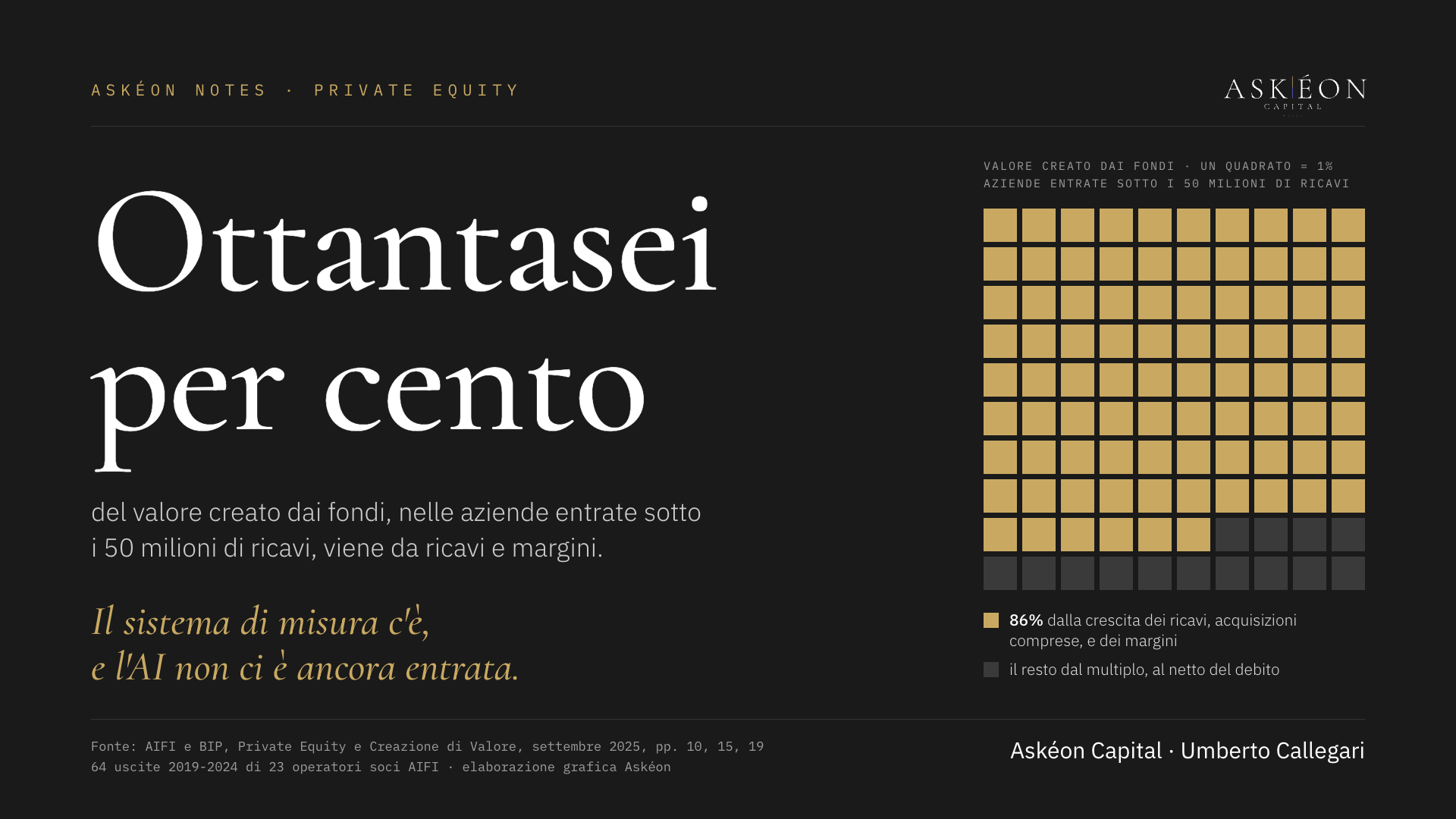
Among the 64 exits analyzed by AIFI and BIP in Private Equity e Creazione di Valore (September 2025), for companies acquired with less than 50 million in revenues, 86% of the value created by the funds comes from revenue growth, acquisitions included, and from margins. Across the whole sample the share is 71%. Acquisitions are done by the deal team; integrating them and building the margin is the operating partner's territory. In the same pages eighteen funds describe their work: operating initiatives are measured with KPIs and monthly reporting, mostly financial; almost all of them mention AI, and in no interview does AI enter those indicators. Whoever brings it into the EBITDA bridge, with a baseline, an owner and a monthly series, gets its savings into the EBITDA the buyer recognizes, and so defends the exit price.
What is inside the 71%
The 64 exits, closed between 2019 and 2024, are the ones that 23 AIFI member operators chose to share, with the selection risk that follows. The 71% adds up revenue growth, 57%, and margins, 14%; the calculation is completed by multiple expansion, 40%, and financial leverage, minus 11%. The negative sign records the net debt that rose during the holding period, from 8.0 to 13.2 million at the median. The debt was used mainly to finance acquisitions, and two companies out of three made at least one: part of the revenue growth, therefore, is bought with debt (AIFI and BIP, 2025).
The 86% concerns 41 of the 64 companies (own calculation based on AIFI and BIP, 2025). For them AIFI writes that the impact of leverage becomes "even more negative", without giving the number: there, net debt weighs more on the value created. AIFI does not say what that debt was used for; across the whole sample it links it mainly to acquisitions. The next buyer separates bought growth, integrated growth and built margin. Margin is the thinnest slice: the median EBITDA margin goes from 15.6% to 17.2% (AIFI and BIP, 2025). It is also the line where AI is giving its first results today, more on costs than on growth (Bain and StepStone, GP Outlook, March 2026).
A bit of arithmetic on the median exit values, which AIFI calculates each on its own: they do not describe a single company (13.7 over 82.2 gives 16.7%, the median margin is 17.2%) and they give the order of magnitude. One point of margin on 82.2 million of revenues is worth about 0.8 million of EBITDA, that is about 7.3 million of enterprise value at the median exit multiple of 8.9 times. Half a turn of multiple on 13.7 million of EBITDA is worth about 6.9 million (own calculation based on AIFI and BIP, 2025).
The work has shifted
In the Global Private Markets Report (February 2026) McKinsey writes that operational value creation is now probably the first source of returns. In buyouts made between 2010 and 2022, leverage and multiple expansion produced 59% of them (StepStone analysis). Since 2021 funds have more than doubled their operating teams on average. These are global data. Bain (Midyear Report, June 2026) adds that active portfolio companies have roughly doubled in ten years, that resources are limited and that it is best to concentrate them on the best companies.
Eighteen interviews
The questions were the same for all eighteen funds. The first asked, among other things, how the fund measures the impact of efficiency initiatives: fourteen answers out of eighteen describe how they measure (KPIs, monthly reporting, comparison with budget); where they say which indicators, these are mostly financial, and revenues, margins or EBITDA appear by name in four. The second named AI among the new technologies and asked which changes the fund expects: sixteen funds mention it explicitly, and the mention is prompted. In the answers AI already appears as an efficiency lever and, in one case, with adoption conditional on return on investment. In no interview does it come with an indicator (AIFI and BIP, 2025). The measurement system is there, and AI has not yet entered it.
Among Italian companies with at least 20 employees, 32% use AI tools in early 2026, 5% intensively, and mostly to optimize existing process steps (Banca d'Italia, Questioni di Economia e Finanza n. 1009, June 2026, Invind survey). The Banca d'Italia itself recalls that with ICT, productivity came with the redesign of processes.
Three objections that lead to measurement
The first is the J-curve. Among companies with at least 20 employees that use AI, 70% say that so far it has not affected labor productivity; half expect an effect in the next three years. On a panel of about 900 companies no systematic effects emerge on revenue per employee, employment and investment, and integration and reorganization costs can arrive before the benefits (Banca d'Italia, QEF n. 1009, June 2026). BCG (January 2026) adds the fund's constraint: quarterly EBITDA targets are in tension with AI spending, and a holding period of about five years can end before payback. If the cost arrives first, the bridge shows it with the expected date of return. Without that date, in the second year the bridge shows only the spending.
The second is the stalled share. 37% of respondents attribute to AI at least some effect on EBIT, about the same share as a year earlier (McKinsey, The state of AI, August 2026, 1,719 respondents, global sample). About 6%, the high performers in McKinsey's definition, attribute to AI at least 5% of EBIT and describe its value as significant. Among high performers, defined processes to measure the impact of AI are twice as frequent as among the others, and almost three out of four have redesigned workflows, against one out of four. It is an association, with no proof of cause.
The third concerns prices, and the discount hits technology. In February 2026 listed software lost almost 30% of its value, then partly recovered, and between the fourth quarter of 2025 and the first of 2026 the value of technology buyouts, add-ons excluded, fell by 70%. Some funds are shifting capital toward companies with physical components or high labor intensity, less exposed to automation (Bain, Midyear Report, June 2026). Read by this criterion, the manufacturing companies in the AIFI sample are on that side: they have physical components, less exposed to automation. AI works on their costs, where funds see the first results (Bain and StepStone, 2026), and the buyer recognizes those savings only if it finds them in the EBITDA. McKinsey (February 2026) describes two outcomes at exit: with productivity gains and operating metrics visible to the buyer, AI supports the valuation; done badly, it can be dismissed as experimental or superficial.
The bridge, line by line
In the bridge, AI enters the lines the operating partner already uses: price, volumes, labor cost per unit produced, purchasing, overheads, integration of add-ons.
- First hundred days. For each initiative: the line it acts on, the owner of that process's margin, the expected date of return. The baseline is measured per unit of process (per order, per case, per invoice) and, where one exists, against a perimeter the tool does not touch yet, such as another plant or a non-integrated add-on: with revenues growing and acquisitions, the before and after on the line does not isolate the effect. The time freed becomes euros only if a line item changes: overtime, external services, avoided hires, extra volumes with the same headcount. 80% of McKinsey respondents see their individual productivity improved, 37% an effect on EBIT (August 2026). The cost includes people, licenses and usage, expensed or capitalized, and it is a line the buyer normalizes.
- Every month. In the portfolio companies of the funds in the AIFI sample, structured monthly reporting "is standard practice" (AIFI and BIP, 2025). The AI lines enter there, in the bridge the board already reads. The reporting is there; it has to be taken to the process level.
- Add-ons. In 2025 they accounted for 53% of private equity deals in Italy (Osservatorio PEM, LIUC with AIFI, as reported by MF, October 2026). In Italian buy-and-build platforms integration has gone from 2-3 to 5-6 years on average, depending on the number of acquisitions, and dedicated teams remain the exception (SDA Bocconi, August 2025). The bridge separates the EBITDA that was bought from the EBITDA improved after integration: it is the buyer's question.
- Mid holding period. According to Bain (June 2026) it is the point where value creation is often lost, and the plan needs to be updated. The AI lines are re-read on the accumulated data: scale, correct, close.
- Exit. The AI line starts after the first hundred days, and the buyer closes its series before the closing. That series, month by month against the baseline, is a trend on which the buyer builds the offer. A savings claim announced without a baseline is an adjustment the buyer can reject.
The family office that buys in series and does not sell brings the same data to the bank and to the next acquisition.
The price
In the AIFI-BIP sample 40% of the value came from the multiple, which AIFI links to size, positioning, governance and internationalization (AIFI and BIP, 2025). The price remains EBITDA times multiple. On the median exit values one point of margin is worth about 7 million of enterprise value, as much as half a turn of multiple (own calculation based on AIFI and BIP, 2025). The point of margin is built in operations, and it is worth those 7 million only if the buyer puts it into the EBITDA on which it applies the multiple. With a baseline, an owner and a monthly series, it gets in. Without them, it remains an adjustment to be negotiated.
UC
Umberto Callegari founded Askéon Capital, operating advisory and selective investments with its own capital. At Microsoft he was Chief Digital Officer Consulting Services, Western Europe, and then Worldwide Commercial Lead, Customer Transformation & Innovation; previously Accenture, Monitor Deloitte and Octo Telematics.
Sources: AIFI and BIP Corporate Finance & Strategy, Private Equity e Creazione di Valore, September 2025 (study by the AIFI research office commissioned by BIP, on data provided by member operators: 64 divestments 2019-2024 by 23 operators; 18 interviews with funds); McKinsey, Global Private Markets Report 2026, February 2026; McKinsey, The state of AI in 2026, August 2026 (1,719 respondents); Bain & Company, Private Equity Midyear Report 2026, 8 June 2026; Bain & Company and StepStone, GP Outlook 2026, 2 March 2026 (103 professionals); BCG, Executive Perspectives, Private Equity: Value Creation in Portfolio Companies, January 2026; Banca d'Italia, Questioni di Economia e Finanza n. 1009, June 2026 (Invind survey, companies with at least 20 employees; panel of about 900 companies); Osservatorio PEM, LIUC with AIFI, 2025 data, as reported by MF, 21 October 2026; SDA Bocconi Insight, Buy&Build: when acquisitions truly create value, 4 August 2025 (PE Lab study on 85 platforms).