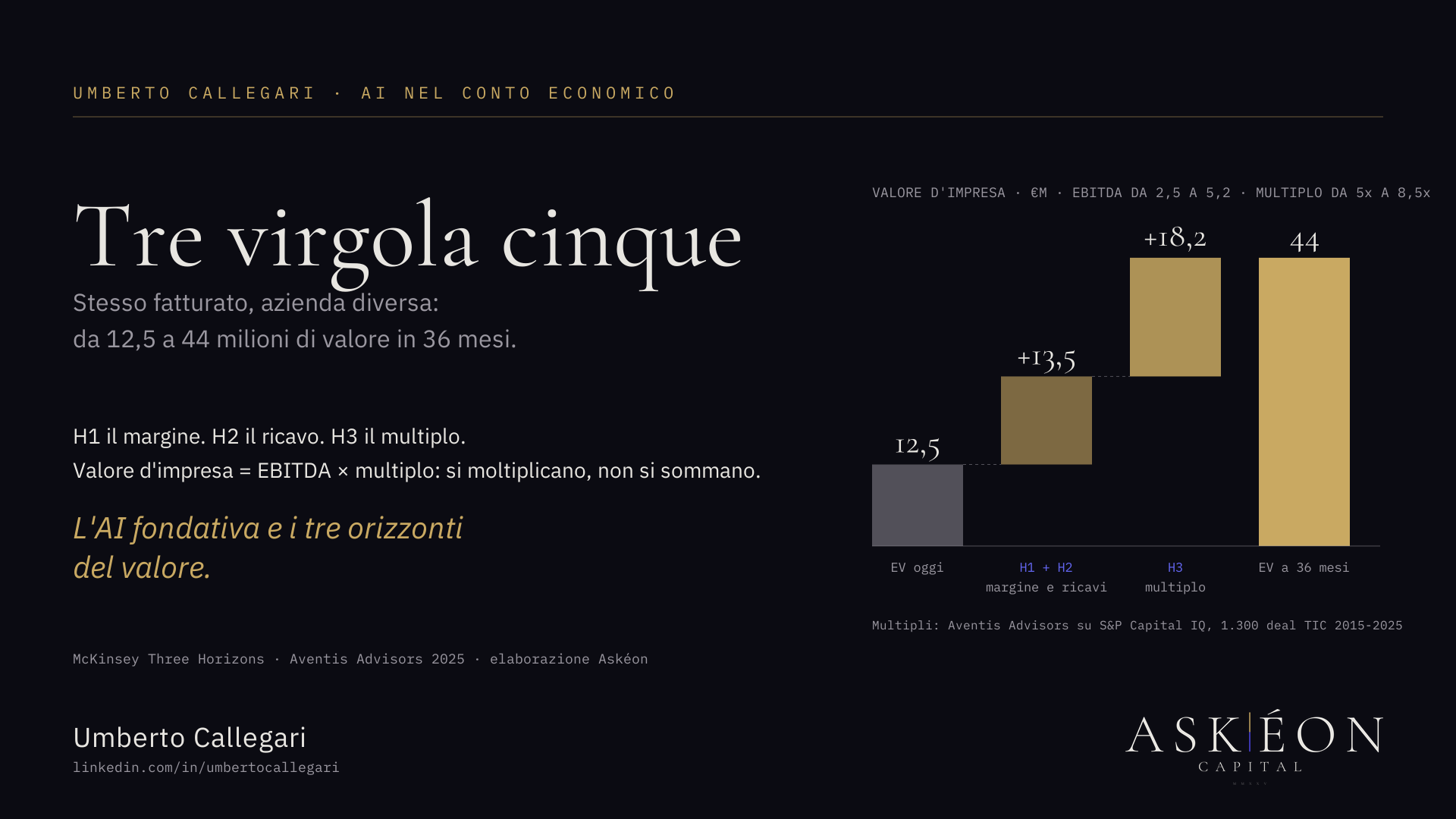
A company worth 12.5 million that is worth 44 three years later. EBITDA from 2.5 to 5.2 million, multiple from 5 to 8.5 times. Three point five times the starting value. This is the arithmetic that results when artificial intelligence works on all three horizons of a company's value instead of just one. And the reason 94% of companies don't see it on their income statement is that they work on the first, at best, and call the rest a pilot.
The framework is McKinsey's three horizons, created for growth and applied here to a technology that, unlike all its predecessors, acts on all three at once. Each horizon has a mechanism, a number, a timeline, and an owner. The three overlap: the second starts when the first begins to pay off, the third when the second is credible. Value is created when they multiply, and the multiplication matters to those who sell, but above all to those who stay.
Horizon one: margin, months 0-24
The first horizon is operational efficiency, and it pays off within the first 24 months. The work is to identify the skilled time that produces no value and automate it: not people's work, but the part of their work that doesn't require their skills. This share exists in every company and is measured with a stopwatch, not an estimate. In an accredited laboratory it is between 20 and 30% of technical time, spent on reporting, chain of custody, sample collection scheduling. In a maintenance company it sits in work reports, intervention planning, invoicing that chases the job site. In a mechanical engineering company it sits in quotes, non-conformity management, quality documentation. Converted into margin, it is worth between three and six points of EBITDA: in a sector where the leaders sit at 12-13% measured on filed financial statements, that means taking them to 15-19.
The mechanism is the same everywhere. You take a process, measure how much skilled time it absorbs and how much of that time is transcription, checking, reconciliation, waiting. You redesign the process around a system that does that part, and people stay on the part that requires judgment. There is one indicator: cost per transaction, whether it is a report, an intervention, a quote, or an invoice. If the cost per transaction doesn't fall, there was no first horizon, whatever the vendor says. The owner is whoever answers for the margin of that process, not the IT function: a function that doesn't control the margin can't put anything into it.
It is the least glamorous work and the safest, and it is what funds the other two. The typical mistake is to start from the third horizon, the most fascinating, without having the first to pay for it. MIT measures it: the pilots that produce a return are in the back office, where the first horizon lives; the budgets are in sales and marketing, where the return is the lowest. In the 12.5 million case, the first horizon takes EBITDA from 2.5 to 3.1: three points of margin on twenty million in revenue. With the multiple unchanged, that is three million in additional value. Not much, on the face of it. They are the three million that pay for everything else, and they are also the proof, in front of a bank or a partner, that the company knows how to turn technology into margin.
Horizon two: revenue, months 6-36
The second horizon is new revenue. Here AI doesn't cut: it accelerates. The product delivered in a third of the time, the quote in an hour instead of a week, the answer that arrives before the customer's question. These are advantages the customer pays for and changes supplier for, and this is what turns the efficiency of the first horizon into market share. A report that goes from ten days to three, for a customer with a permit deadline, is not a better service: it is the only service they need.
The mechanism is the conversion of saved time into commercial capacity. A company that produces the same thing in a third of the time has two choices: reduce headcount or serve three times the customers. The first is the first horizon and ends there. The second is the second horizon, and it is measured in three numbers: cycle time to the customer, quote conversion rate, share of recurring revenue. McKinsey confirms it by difference: the 6% that see AI in EBIT are three times more likely to use it to transform the business than for local efficiency gains, and most are redesigning workflows from scratch. 80% of all the others state efficiency as their goal. The difference between redesigning and making efficient is the difference between the second horizon and the first.
The second horizon has a second leg, and it is the one that weighs most in fragmented sectors: acquisitions. An acquisition is integration, and integration is where most small acquisitions lose the value they paid for: two systems, two ways of making a quote, two customer registries, two years to unify them. A company that has redesigned its processes around a system integrates an acquired company in months: the acquired company joins the buyer's platform, its reports or its interventions immediately become data in the same format, its cost per transaction drops to the parent company's level. It is AI that makes accretive a two- or three-million acquisition that would otherwise remain a separate company with a new logo. In the 12.5 million case, this is the horizon that takes EBITDA from 3.1 to 5.2, half from organic share and half from two small acquisitions integrated in months. With the multiple unchanged, the value goes from 12.5 to 26 million. Plus 13.5. Up to this point the company is the same, larger and more profitable. The market still reads it as a supplier.
Horizon three: the multiple, months 18-36
The third horizon is the change of business model, and it changes the price at which the company is valued by anyone who looks at it: a buyer, a bank, a partner. Every company produces data in the course of its activity: analyses, minutes, interventions, measurements. Today that data is archived; tomorrow it is a product. A laboratory that structures every report becomes, over the years, the holder of its customers' compliance history, and that history is bought by insurers and banks that today price risk blind. A maintenance company that records every intervention builds the digital twin of the plants it serves and sells it as a contract, not as a call-out. The model moves from price per service to recurring revenue on data.
The third horizon cannot be improvised, and that is why it starts at month 18 and not at month 30. The data worth selling exists only if the first horizon has structured it: the report produced by a system is a queryable record, the handwritten report is a PDF. The recurring contract is signed only by a customer who has already seen the second horizon: three days instead of ten. The third horizon is the product of the first two, not an add-on. And it has a precise owner: whoever answers for the whole company, because it changes what the company sells, not how much it costs to produce.
The market prices it accordingly, and already does. In the testing and certification sector, across 1,300 transactions between 2015 and 2025, entry through succession sits at 5 times EBITDA, the small laboratory at 7, the platform between 25 and 100 million at 9.5, listed groups at 13 (Aventis Advisors on S&P Capital IQ). The scale of multiples is a scale of integration: the small laboratory is worth 7 because it is a sum of people, the platform is worth 9.5 because it is a system that absorbs laboratories and makes them perform the same way, the listed group 13 because it does so at scale. Size matters, but it matters because it is integrated: two laboratories side by side with two systems are not a platform and don't get its multiple. In the 12.5 million case, the third horizon takes the multiple from 5 to 8.5: on 5.2 million of EBITDA that is 18.2 million of value, without a euro more of EBITDA. The third horizon doesn't add margin: it changes what the person looking at the company is looking at.
Those who stay
The multiple seems like a topic for those who sell. It is a topic for those who stay, for three concrete reasons.
The first is generational transition. When the company passes to one child and the others have to be bought out, the price of the buyout is EBITDA times multiple. At 5 times, buying out two siblings out of three costs two thirds of 12.5 million. At 8.5 times, the same transition costs two thirds of 44, but it is paid for by a company that generates double the EBITDA and that a bank finances on different terms, because recurring revenue and structured data are exactly what a bank looks at when deciding how much to lend and at what rate.
The second is the partner. A company that brings in a minority partner to grow gives up a stake at the multiple of the day. At a multiple of five, 30% of the company costs 3.75 million and buys little. At a multiple of 8.5, the same 30% is worth 13 million and funds the next acquisition. The entrepreneur who has done the three horizons before opening the capital keeps more of the company for the same money raised.
The third is the second round. Whoever sells the majority and reinvests a stake in the buyer, as often happens in deals involving companies under fifty million, plays the second game with the multiple as the starting point. Whoever enters at 8.5 and takes the platform to 13 with subsequent acquisitions multiplies a second time. Whoever enters at 5 and waits for the buyer to do the three horizons in their place has given away the first round and watches the second from the stands.
The multiplication
The three horizons multiply, because enterprise value is EBITDA times multiple, not EBITDA plus multiple. An EBITDA that doubles thanks to the first two, and a multiple that rises from five to eight and a half thanks to the third, give an enterprise value three and a half times the starting one: 12.5 million becomes 44. Whoever works on a single horizon gets at most the factor of that horizon: 1.2 with margin alone, 2 with margin and revenue, 1.7 with the change of multiple alone, which without the first two nobody recognizes. Whoever does them in sequence, with the first funding the second and the second making the third credible, gets the product.
The sequence also explains why the 94% don't get there. A pilot touches a process, measures a saving, and stops: it is a partial first horizon, without the cost per transaction that would make it real and without anyone to convert it into commercial capacity. 95% of generative AI pilots produce no measurable effect on the income statement (MIT NANDA, 2025, 300 implementations analyzed), and 6% of companies see AI in EBIT, for at least 5% (McKinsey, November 2025, 1,993 respondents). It is not a distribution of luck. It is the distribution between those who have one horizon and those who have three.
The three-horizon plan fits on one page: for each, a number, a month, and a name. Cost per transaction, recurring revenue, multiple. Month 24, month 36, month 36. A process owner, a commercial lead, the chief executive. Whoever has that page has a company worth three and a half times as much, whether they sell it or not. Whoever doesn't has a pilot.
UC
Umberto Callegari is Chairman of Askéon Capital. At Microsoft he was Chief Digital Officer Western Europe and then Worldwide Commercial Lead of the industry advisory; previously Accenture, Monitor Deloitte and Octo Telematics.
Sources: McKinsey, Three Horizons of Growth; McKinsey, The State of AI 2025 (November 5, 2025, 1,993 respondents); MIT NANDA, The GenAI Divide: State of AI in Business 2025 (300 implementations); Aventis Advisors on S&P Capital IQ, TIC M&A 2015-H1 2025 (1,300 transactions); 2024 filed financial statements of sector leaders, Askéon analysis.