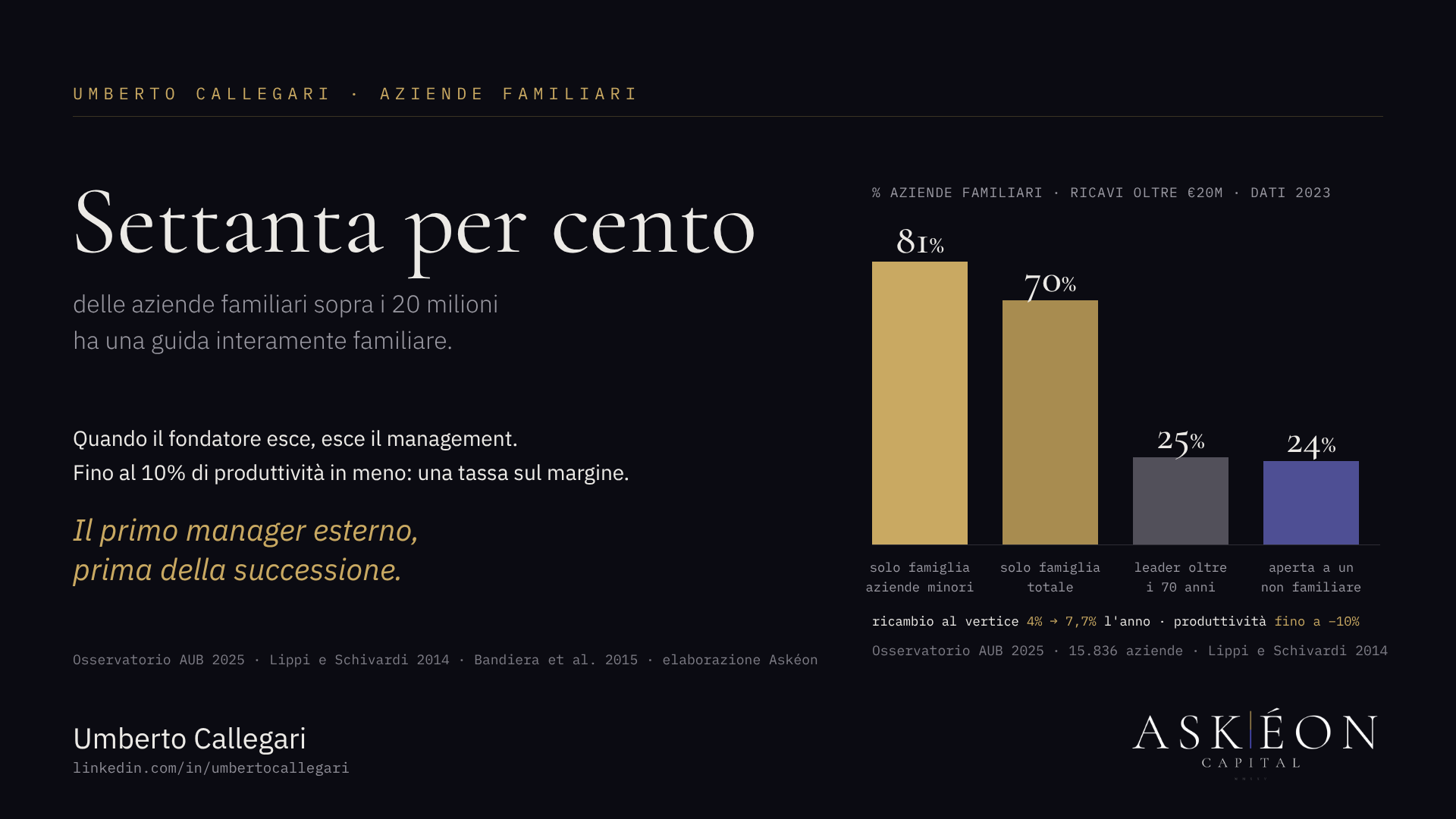
In 70% of the larger Italian family businesses, leadership rests entirely in the hands of the family. Among the smaller ones, above 20 million in revenue, the share rises to 81%. This is what the AUB Observatory of AIDAF, UniCredit and Bocconi measures across 15,836 family-controlled companies, with data as of the end of 2023. Only 24% have a leadership open to a non-family member. One leader in four is over seventy; fewer than two in ten are under fifty.
The number is read as a matter of custom: Italian families don't trust managers. It is a convenient reading, and a wrong one. The number lives in the income statement, and economic research has measured it from three different directions, on Italian data, with three results that say the same thing.
Ten points of productivity
Whoever controls a company also draws from that control a return that doesn't pass through the balance sheet: the family's prestige, a job for a son, the loyalty of an executive who has been there for twenty years. Francesco Lippi and Fabiano Schivardi measured it on matched employer-employee data from Italian manufacturing firms, with the complete work histories of the executives. The private return enters the choice of who runs the company: you keep the person you know even when a more productive replacement exists, and you give up looking for one. It is larger in family-controlled and publicly controlled companies than in those controlled by a group or a foreign owner. The distortion in executive selection alone explains differences in total factor productivity across types of control of up to 10% (Quantitative Economics, 2014).
Ten points of total factor productivity are ten points more output with the same people and the same capital. On twenty million in revenue that is two million, which for most companies of that size is worth more than the entire EBITDA. The cost of family management is not a tax on growth. It is a tax on margin, paid every year, that no balance sheet reports as a line item.
The manager who chooses the family
The second mechanism lies in contracts. Oriana Bandiera, Luigi Guiso, Andrea Prat and Raffaella Sadun matched a sample of 603 Italian executives in the services sector with their pay over their entire careers and the financial statements of the companies that employ them. Family firms pay bonuses tied to individual results in 44% of cases, against 57% for widely held companies; they have accelerated career paths in 32% of cases against 41%; they have fired an executive for missed targets in 3% of cases against 6% (Journal of Labor Economics, 2015).
The consequence is a selection mechanism that works in reverse. The executive who accepts a flat contract is the risk-averse one; the talented one goes where he is paid on results, and companies that pay on results have higher profits. A family firm that opens up to an outside manager without changing the contract hires the manager who was looking for a quiet job, and after three years concludes that outside managers don't work. It hasn't tested the manager. It has tested the contract.
Nicholas Bloom and John Van Reenen measured the quality of management practices in 732 medium-sized manufacturing firms in the United States, the United Kingdom, France and Germany. Management practices are strongly associated with productivity, profitability, growth and survival. Family firms that pass control to the eldest son sit in the tail of the worst managed, and weak competition plus primogeniture explain about half of that tail (Quarterly Journal of Economics, 2007). Italy is not in the sample. The mechanism is.
What happens when you hand over the reins
The third piece of data is the most useful, because it measures the opposite. The AUB Observatory compared the roughly 1,500 family firms that completed a generational handover between 2013 and 2022 with those that did not, looking at the three years after against the three years before. Those that handed over the reins did better on all six indicators: revenues up 1.1 points a year, fixed investment up 3.6 points, ROA up 0.4 and ROE up 1.3 points, labor productivity up 0.6 points, debt to EBITDA down 0.3 points a year.
The effect is amplified when the successor has worked at least one year outside the family firm, at least six months abroad, and holds a master's degree. And this is where the 70% comes back: fewer than two family successors in ten have had significant work experience outside the group, against seven in ten among outside managers; one in twenty has worked abroad, against one in ten. The lever that makes the handover pay off is the same one the 70% rules out: skills built outside the family perimeter.
The same Observatory adds a finding that is uncomfortable for anyone who wants to simplify: in the 2020-2022 three-year period, the one of discontinuities, companies with family leadership reacted better than those with outside leaders, while those led by leaders over seventy did worse than all the others. The problem is not the family at the helm. It is the family as the only management.
Why the number matters now
Redesigning a process around artificial intelligence requires a person with three things: the mandate over that process's margin, the time to stay inside it for eight to twelve weeks, and a contract that pays on results. In the 6% of companies that see AI in EBIT, the decision sits at the top, with whoever answers for the margin (McKinsey, The State of AI 2025). In a company where the management is entirely family, whoever answers for the margin is the founder, and his calendar is the bottleneck of every project. The 94% that don't see AI on the balance sheet don't have a technology problem. They have a problem of managerial capacity available to change how work gets done.
This is why the first outside manager and the first redesigned process are the same project. A process has a cost per transaction before and after, and a contract tied to that number is the contract that Bandiera and colleagues find in the companies that perform best. The outside manager comes in with a measurable mandate; the family learns to evaluate an executive on a number instead of on trust; the company gains the first person who knows how to redesign a process and who is not the founder. The AUB data point in the same direction: 70% of companies with direct investments abroad have at least one non-family director, against 49% of those without; companies that have opened their capital to a minority stake show above-average operating profitability and growth from the first year; among listed companies, 48% have a leadership open to non-family members, double the average.
Time
Until 2019, turnover at the top affected 4% of family firms per year. In the 2020-2022 period it rose to 7.7%, and generational handovers from 127 to 181 per year. At this pace, with one leader in four over seventy, most transitions will happen in the next decade, and they will happen in companies where no one, besides the person leaving, has ever had the mandate to decide. The Observatory measures the effects of the handover over three years: that is the minimum time it takes for an outside manager to become a result on the balance sheet. Whoever brings one in on the day of succession pays three years of learning at the worst possible moment. Whoever brings one in earlier arrives at the transition with a management that already exists.
This is why, in the way we work, people come in from day one, not at the end. The Diagnosis tells you where the margin is and which processes produce it; the first redesigned process is the mandate of the first outside manager, with an indicator in the income statement and part of the compensation tied to that indicator; where needed, we take the operating role on a temporary basis, along with a seat on the board, until the manager is in place. We are not a fund and we don't buy the companies we accompany: we ask the family to do before the transition what the 30% have already done.
Seventy percent is the share of Italian companies where, when the founder leaves, the management leaves with him. The problem is not who leads. It is that there is no one else.
UC
Umberto Callegari is Chairman of Askéon Capital. At Microsoft he was Chief Digital Officer Western Europe and then Worldwide Commercial Lead of the industry advisory; previously Accenture, Monitor Deloitte and Octo Telematics.
Sources: Osservatorio AUB, XVI edition, Cattedra AIDAF-EY Bocconi, UniCredit, AIDAF, February 3, 2025 (15,836 family firms above 20 million in revenue, 2023 data; difference-in-difference analysis on generational handovers 2013-2022); Lippi and Schivardi, Corporate Control and Executive Selection, Quantitative Economics, 2014; Bandiera, Guiso, Prat and Sadun, Matching Firms, Managers, and Incentives, Journal of Labor Economics, 2015 (603 Italian executives); Bloom and Van Reenen, Measuring and Explaining Management Practices Across Firms and Countries, Quarterly Journal of Economics, 2007 (732 firms); McKinsey, The State of AI 2025 (1,993 respondents).