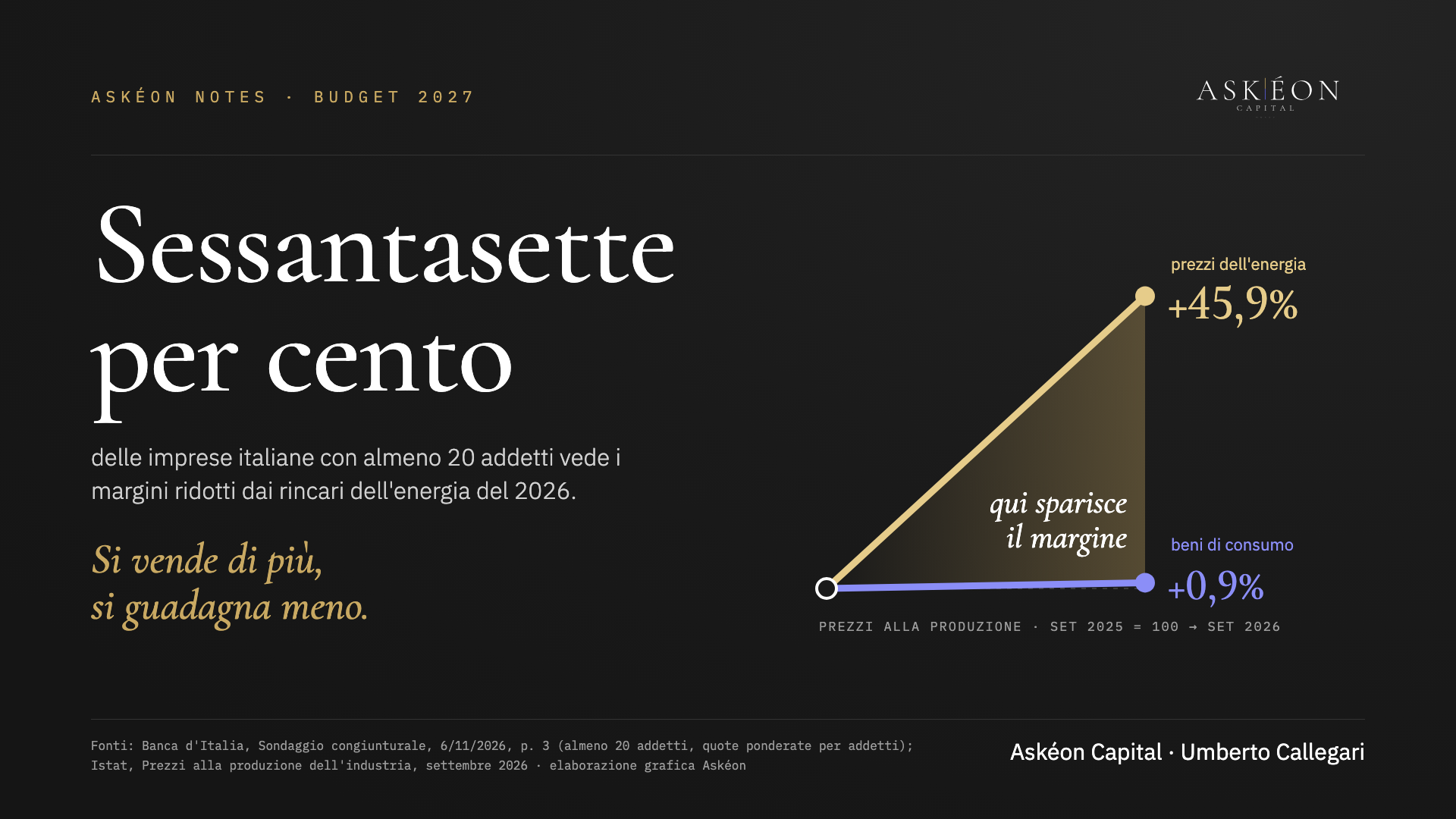
For 67% of Italian industrial and service firms with at least 20 employees, the 2026 energy price increases have reduced profit margins, or will reduce them by year-end. In the same survey, the balance between firms that saw revenue grow in the first nine months and those that saw it fall rises to 26 points, the highest value since 2022, partly because of the trend in selling prices (Bank of Italy, Survey on Industrial and Service Firms, 6 November 2026, shares weighted by employees). Firms sell more and earn less. November is budget month for 2027. The price of energy remains outside a company's control. AI works on what the company does control: quantities purchased, inventory, consumption, selling price. That is where AI's first year enters the budget, and where a fund sees it in EBITDA, before it shows up in revenue.
What the 67% measures
The Bank of Italy's question asks whether the energy price increases recorded since the beginning of 2026 have had, or will have by year-end, an effect on purchasing costs and margins. The answer is a judgment, with no margin points attached. For 84% of firms, purchasing costs have risen, especially in the energy sector and in chemicals, rubber and plastics. The squeeze on margins is more widespread among firms with at least 500 employees, and more contained among those that depend on neither petroleum products nor gas (Bank of Italy, 2026).
Prices explain the pressure. In October the wholesale price of electricity averaged 230.8 euros per megawatt-hour, against a 2025 average of 115.9; gas averaged 88.4 euros, against 38.5 (ARERA, bulletin of 10 November 2026). Between September 2025 and September 2026, producer prices for energy rose by 45.9%, those for intermediate goods by 6.4%, those for consumer goods by 0.9% (Istat, 28 October 2026). Costs rise upstream faster than prices downstream. The difference comes out of the margin.
The picture has a second side. 81.4% of firms expect to close 2026 with a profit (Bank of Italy, 2026): the highest share in the series, which starts in 2000, slightly above 2023 and 2024 (Askéon analysis of Bank of Italy historical series). Balance sheets are holding up. The margin is thinning just as revenue grows, and revenue that grows because of price lists covers the erosion for one year. In the 2027 budget that cover is not guaranteed: in April and May wholesale electricity had returned close to the 2025 average (ARERA, 2026), and whoever plans on the price level alone is planning on a variable they do not govern.
Where the margin sits
In Italian manufacturing, value added is 25.7% of revenue and labor cost is 14.4% (Askéon analysis of Istat, Business economic accounts, 2024 data). The rest, about three quarters of revenue, is goods, energy and services purchased: roughly five times the cost of labor (Askéon analysis of Istat data). One point saved on purchasing weighs on the margin about as much as five points saved on payroll.
Italian firms' AI works elsewhere today. Among firms with at least 10 employees that use it, 33.1% employ it in marketing and sales, 10.2% in accounting and management control, 6.1% in logistics; 33.4% indicate no business purpose at all (Istat, Enterprises and ICT, December 2025). Among firms with at least 20 employees, 32% use it as of early 2026, 5% intensively, and 70% of those who use it say that so far it has not affected labor productivity (Bank of Italy, Occasional Papers (QEF) no. 1009, June 2026). The tool has come in, and it mainly serves to optimize existing process steps. Redesigning processes, which according to the Bank of Italy is the condition for productivity to rise, remains rare.
Where AI has been adopted, balance sheets show higher profitability. Among firms with at least 50 employees that consider AI important, because they already use it or intend to adopt it within two years, 54% indicate improving production and support processes as the main use; according to the authors, the EBITDA margin on sales rises by about two points compared with firms that consider it unimportant; in the table of the same study the coefficient is 4.3 points (Bank of Italy, QEF no. 1005, March 2026). The study's definition of AI includes cloud and robotics, the comparison is with firms that do not consider it relevant, and the date of adoption is not observed: the result indicates a direction, to be measured afterwards in-house.
Four lines of the budget
The 2027 budget already has the lines on which AI can work. Each has a measurable starting cost.
- Purchasing. A quarter of firms have bought inputs made in China since 2025, mainly for cost reasons, and against Chinese competition firms rely mostly on differentiation and on containing production costs (Bank of Italy, 2026). Consulting firms report savings of up to 15% on purchasing with AI, without saying on what sample (BCG, August 2026; Bain, October 2026). A budget should use them only after measuring them in-house: price paid per code, per supplier, per month, against the same series a year earlier.
- Inventory. In a spare-parts chain, the reorder algorithm corrected by people yielded 4.92% more profit than pure automation, and the authors write that forecast accuracy does not necessarily translate into profit (Kesavan, Kushwaha and Steele, Management Science, January 2026). Inventory is idle cash: with borrowing rates worsening for 28.2% of firms and improving for 11.0% (Bank of Italy, 2026), every day of cover removed frees up working capital.
- Energy. The price of energy remains out of control; consumption, load profiles, contracts and plant scheduling remain within it. The Bank of Italy records less compressed margins for firms that depend on neither petroleum products nor gas (2026). The IEA estimates, in a widespread-adoption scenario to 2035, energy savings of 8% in light industry thanks to AI (Energy and AI, 2025). It is a scenario: the measurement is done at the plant, kilowatt-hours per unit produced.
- Pricing. In an eight-day randomized experiment at a US metals distributor, giving the salesperson the price suggested by the model increased profit on the treated quotes by 11% (Karlinsky-Shichor and Netzer, Marketing Science, 2024; figure from the working paper version). It is a single company. The point holds for all: when costs rise, pricing discipline decides how much of the increase passes through to the customer.
In all four lines the method is the same: a baseline per unit of process, an owner, a monthly series. Without a baseline the saving is an estimate. With a baseline it is a line of the income statement.
The budget a fund reads
In funds' portfolio companies, margin moves slowly. In the 64 exits analyzed by AIFI and BIP, the median EBITDA margin goes from 15.6% at entry to 17.2% at exit, over a holding period of about five years (Private Equity and Value Creation, September 2025). 1.6 points in five years. A point of margin lost in 2026 to energy and not recovered in 2027 is worth over 60% of the rise in the median margin over an entire cycle (Askéon analysis of AIFI and BIP: 1 point out of 1.6).
The return demands more. In an illustrative example on large US buyouts, to multiply capital by 2.5 times in five years today requires EBITDA growth of 10-12% a year, against 5% in 2015 (Bain, Global Private Equity Report 2026). With multiples that no longer expand on their own, that growth has to come through the income statement. AI that enters the 2027 budget on purchasing, inventory, energy and pricing works on the part of that growth that depends on the company.
Portfolio companies start with an advantage. Compared with firms comparable by sector, size and area, they are larger, more profitable and better capitalized (Bank of Italy, QEF no. 1061, October 2026). They usually also have monthly reporting on which to measure. For the operating partner, the November budget is the moment to decide which AI lines enter the series the board reads every month, and with what expected date of return.
The first horizon
Revenue driven by price lists covers the margin erosion for one year. In 2027 the cover depends on external variables. AI's first horizon lasts twelve months and defends margin with the levers the company governs: how much it buys, how much it holds in stock, how much it consumes, at what price it sells. Revenue and new models come after, and they are financed by the margin defended in the first year.
UC
Umberto Callegari founded Askéon Capital, operational advisory and selective investments with its own capital. At Microsoft he was Chief Digital Officer Consulting Services, Western Europe, and then Worldwide Commercial Lead, Customer Transformation & Innovation; previously Accenture, Monitor Deloitte and Octo Telematics.
Sources: Bank of Italy, Survey on Industrial and Service Firms, 6 November 2026 (firms with at least 20 employees, shares weighted by employees) and historical series; ARERA, Bulletins of the Energy Oversight Unit, 2026 (GME wholesale prices); Istat, Producer prices in industry and construction, September 2026 (28 October 2026); Istat, Economic accounts of enterprises and groups, year 2024 (15 October 2026); Istat, Enterprises and ICT, year 2025 (15 December 2025); Bank of Italy, Occasional Papers (QEF) no. 1009 (June 2026), no. 1005 (March 2026) and no. 1061 (October 2026); S. Kesavan, T. Kushwaha, D. Steele, Management Science 72(1), 2026; Y. Karlinsky-Shichor and O. Netzer, Marketing Science 43(1), 2024 (figure from the working paper version, SSRN 3368402); BCG, AI in Procurement Drives Competitive Advantage, 7 August 2026; Bain & Company, AI Is Turning Procurement into an Earnings Engine, 14 October 2026; IEA, Energy and AI, 2025; AIFI and BIP Corporate Finance & Strategy, Private Equity and Value Creation, September 2025; Bain & Company, Global Private Equity Report 2026.