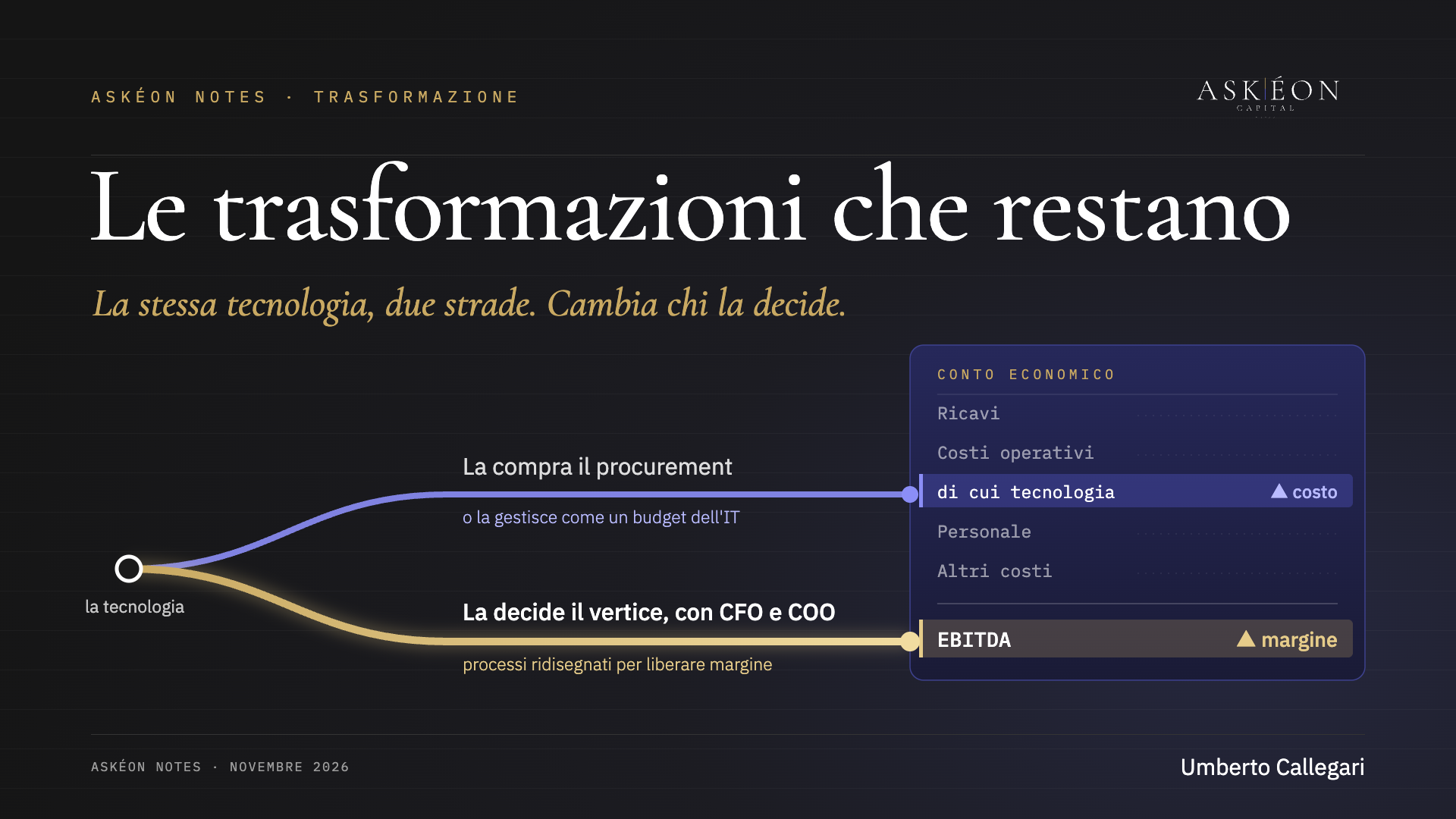
Technology reaches the P&L when it is decided as a P&L line. Bought by procurement or managed as an IT budget, it remains a cost to be negotiated. Decided from the top as a line of the plan, with the CFO measuring it and the COO redesigning the processes, it frees up margin. The 2026 data point in this direction: 37% of companies attribute at least some EBIT impact to AI, the same share as a year ago, while the share scaling it across the whole enterprise rises from 38% to 44% (McKinsey, The state of AI in 2026, August 2026). Adoption is growing, but the share that sees it in the P&L is flat.
For fund portfolio companies the issue weighs even more. 79% of the GPs surveyed by Bain and StepStone expect flat multiples, and about three in four build into the plan stable margins or margins growing by up to 300 basis points between purchase and sale (Bain and StepStone, GP Outlook 2026, March 2026). Without help from multiples, margin has to be built inside the company.
More usage, same P&L
Gartner asked 2,002 CIOs and technology executives how much value they have obtained from AI. 13% report significant or transformative value, and one use case in five makes it to the end (Gartner, CIO and Technology Executive Agenda 2027, October 19, 2026). The analyst Alicia Mullery summed it up in four words: “Volume is not value.”
The numbers should be read with caution. BCG, surveying 1,330 executives, finds that almost half of companies already obtain significant value (BCG, The Formula for Agentic AI Value, September 30, 2026). McKinsey, Gartner and BCG measure different things, with different thresholds. The common point lies elsewhere: in all three studies the value is concentrated in a small group of companies, and that group does recognizable things.
Who decides
Spending has already shifted. Companies spend 3.3% of revenue on AI, double a year ago, and more than 80% of that spending sits outside the IT budget. Among the most advanced companies the program is entrusted to the top, and 95% measure it with clear indicators or directly in the P&L; 61% have moved from isolated pilots to a multi-year program across the whole enterprise (BCG, September 30, 2026). 54% of finance leaders drive capital allocation decisions on AI and technology, and 48% control its spending and costs (Deloitte, Finance Trends 2027, September 9, 2026).
The companies that get results write them down where the accounts are written. DBS puts the economic impact of data and AI in the CFO statement: about S$1 billion in 2025, against S$750 million in 2024, and the same statement says that investments in digital, data and AI have delivered tangible improvements in ROE (DBS, annual reports 2025 and 2024). Travelers points to the line where the gain ends up: claims efficiency flows through claim adjustment expenses and therefore the loss ratio, with claims call center staff down by a third (Travelers, earnings call, January 21, 2026).
Deciding on the P&L also means knowing how to stop. Only 31% of CIOs say they have criteria for deciding when a pilot should not go into production, and only 17% for switching off what in production yields little. Those who have them are found 2.3 and 2.6 times more often among the companies with the best results (Gartner, October 19, 2026).
Redesigned processes
Among the companies that attribute at least 5% of EBIT to AI and see significant value from it, almost three in four have thoroughly redesigned their processes, against 55% a year earlier. Among the others, one in four has done so. The same companies are twice as likely to have a committed leadership team and a defined method for measuring impact (McKinsey, 2026). BCG has recommended a proportion for years: 10% of the effort to algorithms, 20% to technology and data, 70% to people, organization and processes (BCG, 2024 and 2026).
The skeptic has arguments. The best companies also spend more on AI, and 80% of respondents say AI has improved their individual productivity (McKinsey, 2026). It is not known whether redesign produces the results or whether those who already have results have more room to redesign. The individual gain, however, stays within the person's working day. To reach the P&L it has to pass through a process.
In fund portfolio companies
In buyouts, the excess return over listed competitors goes hand in hand with revenue growth and EBITDA margin improvement higher than theirs (Acharya, Gottschalg, Hahn and Kehoe, Review of Financial Studies, 2013, on 395 deals in Western Europe). Technology treated as a P&L line works on those two items.
In the portfolio company, the CEO brings technology into the plan and the CFO measures it. One third of respondents in a Deloitte survey estimate that a good CFO can be worth 20% or more of the value realized at exit, and three investors in four usually replace the CFO in more than half of their portfolio companies; finance is asked to be also a catalyst of organizational and digital transformation (Deloitte, Catching the wave, winter 2025). Leadership changes often: 65% of funds change the CEO during the holding period (AlixPartners, March 2026).
Two large portfolio companies show where the value ends up. Ingram Micro, controlled by Platinum Equity, points to operating cost efficiency as the first phase of value from its digital platform Xvantage. In the fourth quarter of 2025 operating expenses fell to 4.41% of revenue, from 5.15% a year earlier, and the CFO attributes this also to Xvantage optimization and automation, in addition to an insurance reimbursement; in the same quarter adjusted operating margin rose only from 2.29% to 2.35%, because gross margin fell by 51 basis points due to a less profitable sales mix, above all PCs and Asia-Pacific, and by more than 15 basis points due to large AI infrastructure projects (Ingram Micro, fourth quarter 2025 results, March 2, 2026).
Verisure, of which Hellman & Friedman is the largest shareholder (43.7% at the end of 2025), has put AI at the center of its 2026 cost program to reduce the cost of service. Computer vision in cameras and sensors has already cut by 28% the alarms to be handled, and in the fourth quarter of 2025 guard interventions fell by 11%. In 2025 adjusted EBIT margin rose by 141 basis points, to 25.4%, with €80 million of savings from a cost program that the company does not attribute to AI (Verisure, 2025 results, February 12, 2026).
For Bain, a single use case that reaches the P&L, “a single home run use case that reaches the P&L,” is worth more than dozens of pilots (Bain, Getting Past the AI Value Paradox in Private Equity, September 16, 2026). GPs remain cautious: 39% do not expect any material financial effect from AI on their portfolio companies in 2026, 46% expect mainly savings and efficiency, 10% revenue growth (Bain and StepStone, March 2026).
In Italy
In 2025, 71% of large Italian companies launched at least one AI project, against 59% in 2024. Only one in five, however, uses AI extensively across multiple functions, and just 9% have a structured governance with defined responsibilities. Among small and medium-sized enterprises, only 8% have launched at least one project (Osservatorio Artificial Intelligence, Politecnico di Milano, February 2026). The average remains modest outside Italy too: according to almost 9,000 executives in seven countries, AI has added 0.2% a year to labor productivity growth over the past three years (NBER, Working Paper 34836, October 2026).
Three conditions
The transformations that last have three conditions in common. A P&L line, with a baseline measured before starting. A decision from the top, with the CFO measuring and the COO responsible for the processes to be redesigned. A rule for stopping what does not pay off. In a portfolio company they translate into three acts: choose the line and measure its baseline, assign process and number to one owner, write into the monthly board pack the threshold below which the project stops. This is how technology enters the value creation plan and the numbers presented at exit.
UC
Umberto Callegari at Microsoft led strategic advisory for large clients globally, using AI as a strategic and operational lever on their P&L, as Worldwide Commercial Lead, Customer Transformation & Innovation, after serving as Chief Digital Officer, Consulting Services, Western Europe; previously at Accenture and Monitor Deloitte. With Askéon Capital, which he founded, he works with entrepreneurs and funds to bring AI and technology into the P&L, and he is Chairman of Excursus Group.
Sources: Bain & Company and StepStone, Private Equity's Reality Check: The GP Outlook for 2026, March 2, 2026 (103 fund professionals); Bain & Company, Getting Past the AI Value Paradox in Private Equity, September 16, 2026; V. Acharya, O. Gottschalg, M. Hahn, C. Kehoe, Corporate Governance and Value Creation: Evidence from Private Equity, The Review of Financial Studies 26(2), 2013; Deloitte, Catching the wave: The role of PE portfolio CFOs in maximising value on exit, winter 2025 (213 responses); AlixPartners, 11th Annual Private Equity Leadership Survey, March 25, 2026 (427 executives); Ingram Micro, fourth quarter 2025 earnings call, March 2, 2026; Verisure, 2025 results presentation, February 12, 2026; McKinsey & Company, The state of AI in 2026: On the road to ROI, August 25, 2026 (1,719 respondents); Gartner, 2027 CIO and Technology Executive Agenda survey, press release of October 19, 2026 (2,002 CIOs and technology executives); BCG, The Formula for Agentic AI Value and press release of September 30, 2026 (1,330 executives); BCG, Where's the Value in AI?, October 24, 2024; Deloitte, Finance Trends 2027, press release of September 9, 2026 (1,434 finance leaders); DBS Group, Annual Report 2025 (CFO statement) and 2024 (CIO statement); Travelers, fourth quarter 2025 earnings call, January 21, 2026; Osservatorio Artificial Intelligence, Politecnico di Milano, press release of February 2026; I. Yotzov, J. M. Barrero, N. Bloom and others, Firm Data on AI, NBER Working Paper 34836, October 2026 revision.